For the anniversary of my death

I didn’t know this poem by W. S. Merwin until recently. On first read it felt so somber, and tonight on New Year’s eve, not the usual fare for ringing in the coming year. Yet, somehow it seems appropriate now, and I hear the gratitude in it. The bowing to the unanticipated and commonplace gifts of the passing year.

The anniversary of your death approaches, Kissie. I think of all the years before when we passed “the day” without knowing it. And when finally, by grace, we saw that unbidden day approaching (an experience I will ever try to somehow articulate) it was indeed a strange garment and still surprising, and the morning birds, somehow, sang.

For the Anniversary of My Death | W.S. Merwin

Every year without knowing it I have passed the day   
When the last fires will wave to me
And the silence will set out
Tireless traveler
Like the beam of a lightless star

Then I will no longer
Find myself in life as in a strange garment
Surprised at the earth
And the love of one woman
And the shamelessness of men
As today writing after three days of rain
Hearing the wren sing and the falling cease
And bowing not knowing to what

Each grief a reflection of relationship

My elderly mother-in-law died seven weeks ago. It was a long decline spanning the last 18 months and punctuated by numerous and increasing health issues, notably dementia and cancer. The end of her life brought a level of care-giving and involvement for which neither my husband nor I were adequately prepared. For me, taking on such huge, additional responsibilities, though shared, was overwhelming, especially while grieving my sister.

What has stuck me most in these intervening weeks since her death, is the nature of my husband’s grief and how intrinsically their distinct relationship has determined the character and nuance of it. This has, in turn, brought my own grief into sharper relief. Each grief for someone is so very personal. It is marked by all that we were and meant to each other, how we interacted, what was shared and withheld, and how — over time — we grew emotionally closer, or apart, and how we therefore arrived at the time of parting. It all comes to bear at last on how and why we grieve, and how we will face our own deaths.

We also bring these very personal experiences to our expressions of condolence and sympathy. So much is framed by our unique relationships and circumstances, that drawing too much on assumed similarities can, at the very least, render the expression less meaningful. I’ve noticed how my condolences to others reflect my own grief and relationships. Though there are many parallels to be drawn and unities to be embraced as I contemplate death and mourning, my awareness of others’ discrete relationships gives me a richer understanding of my own grief, and hopefully, a more mindful appreciation of theirs.

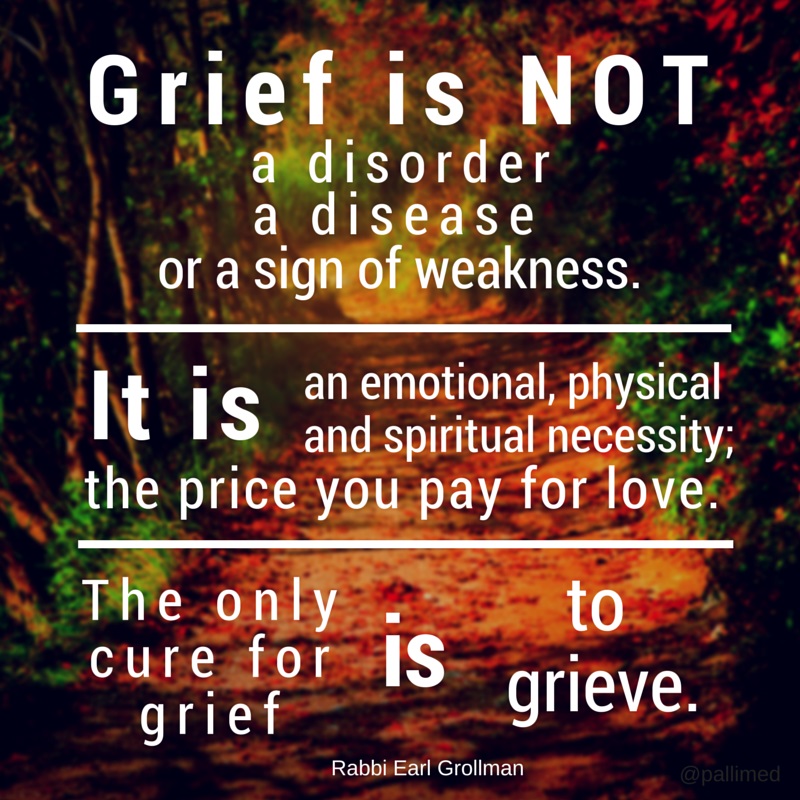
Grief is not a disease

Grief

Rabbi Dr. Earl Grollman is a past chairman of the National Center for Death Education, and a renowned bereavement author, speaker, crisis intervention specialist, and grief counselor.

What if Grief is a Skill?

“What if grief is a skill, in the same way that love is a skill, something that must be learned and cultivated and taught? What if grief is the natural order of things, a way of loving life anyway? Grief and the love of life are twins, natural human skills that can be learned first by being on the receiving end and feeling worthy of them, later by practicing them when you run short of understanding.”
– Stephen Jenkinson


These questions from Stephen Jenkinson, author of Die Wise: A Manifesto for Sanity and Soul, continue to challenge my beliefs about the nature of grief each time I read them. If grief is a skill – and I’m ever more certain it is – then what am I doing to learn it more comprehensively? I’ve definitely been on the “receiving end” with not only the physical deaths of those I love, but with endings and transitions in relationships, livelihood, health, dreams – the countless and sundry goodbyes that are part and parcel of living.

How can grief and the love of life not be twins? They’re inseparable, and yet we continue to polarize them. We badmouth grief and hold it apart from the love of life like an island we’re banished to when things get really bad, and if we dwell there too long, we’re in trouble. Maybe we don’t feel worthy of grief at all considering the ways we attempt to avoid it? And if that’s true, then how can we feel worthy of love?

I am worthy of my grief for Kissie because I was worthy of her love, and she of mine. I don’t believe they could exist without each other. I love life anyway. Intensely so. I “practice” my grief by experiencing it, writing about it, talking about it, and questioning the ways in which our culture hinders its acceptance and expression.  How do you practice?

Grief as an Act of Protest

“Grief undermines the quiet agreement to behave and be in control of our emotions. It is an act of protest that declares our refusal to live numb and small. There is something feral about grief, something essentially outside the ordained and the sanctioned behaviours of our culture. Because of that, grief is necessary to the vitality of the soul. Contrary to our fears, grief is suffused with life force… It is not a state of deadness or emotional flatness. Grief is alive, wild, untamed and cannot be domesticated… It is truly an emotion that rises from the soul.”
-Francis Weller


In his resonant and challenging description of grief, psychotherapist and author Francis Weller declares that grief is “necessary to the vitality of the soul” because it is “untamed and cannot be domesticated.” I think that’s why grief scares us so much, and why we create “rules” for its expression, and diagnoses for when we think it has run amok. In acknowledging the predominant and unspoken agreement to be emotionally restrained, even numb, when it comes to mourning, Weller asserts that embracing our grief openly is tantamount to cultural rebellion! It certainly feels that way to me, and continuing to grieve for Kissie past some socially approved expiration date, is not only my act of personal protest, but truly a kind of sustenance for my psyche that is, as Weller put it, “suffused with life force.”  I’ve never heard anyone refer to grief as a life-giving emotion, and what a relief to know I’m not alone in this experience. In shunning our grief, we are inadvertently thwarting our essential capacities for passion, vigor, and the love of life.


Channeling Anger

I’ve been asked if I’m angry about your death. I am. I suppose the question came up because the friend who asked hasn’t seen me express it, at least not openly, in it’s unrestrained, torrential state.  I’m glad she asked, though. Since then, I’ve been paying more attention to my occasional outbursts, or the slow-building broody weeks that seem to catch me by surprise, with no seemingly outward catalyst.

Yes, there among the myriad emotions and memories and reflections about your illness and death, and my life in the wake, anger exists. And, like most emotions, it doesn’t hold up well to rationale when I’m feeling it full-force. With a little distance, I’ve been able to get some perspective, and have some empathy toward myself. I love this quote by Harriet Lerner: “Anger is a signal, and one worth listening to.”

I’ve noticed that anger is not a predominant aspect of my grief for you (I don’t feel mad at you for dying, for instance), but I definitely get good and angry when I recall some of the circumstances surrounding your death, and the attendant interpersonal and cultural dynamics then, and since. I’m angry with myself for some of my decisions. I’m angry that you suffered so much. I’m angry that our culture shuns and minimizes grief and grievers, and that we consider death itself so unconscionable that we inadvertently harm those we love who are dying. To name but a few.

I sometimes don’t know what to “do” with my grief-anger. It does, occasionally, come out sideways – a sure sign I have some acknowledging to do. Part of the channeling of my anger is this blog – a place to expend the energy, examine the disappointments and expectations that fuel it, and simply to offer it, in honor and love, for you.


Shelter

Over the many years you were sick, from time to time, I would try to imagine what I would feel, how I would cope, if you died. It wasn’t a question of when, really, unless there was a setback and a new treatment protocol – a storm to weather. Then, that far off time would inch closer, only to retreat again until the next threat. Unfailingly, you lived for the day. More than anyone else, you taught me to seize it, and the people in it, with wholehearted exuberance. We were shelter – each to the other. I couldn’t possibly have imagined how I would feel, or deal. Your death is beyond precedent in my life, despite the deaths of many of our loved ones before it. And because there was, and continues to be, no cultural framework for learning about dying and grieving as skills, I find myself searching for some kind of community engaged in creating one.

Some friends and I were talking recently about the “club.” Like other clubs of similar ilk, the cancer club most notably,  it’s one you never want to join. But there you are, and you gravitate to others who can relate most keenly because of the magnitude of the death they’ve experienced. A death that levels you. Shatters any semblance of life as you knew it. They know what you’re talking about as you all nod your heads about death having its way with you. And what life is like now.

This is the company I seek, and have been fortunate to find, especially when I’ve needed it most. Companions with whom I feel a strange and comfortable refuge and authenticity, even if I don’t know them well. It’s unorganized, impromptu, and feels rather “underground.” It’s balancing, and clarifying, and loving. Like you, it’s shelter.

Unwelcome Guests

Missing you hurts like hell, Kissie. It’s a fact of my life now. How could it be otherwise? I’m socially conditioned to judge my pain, so I struggle not to. I don’t think it’s productive, it doesn’t change anything, and it feels harmful. I’m convinced that judging my emotional pain also perpetuates the grief phobia I observe and experience regularly. It’s really difficult to stay out of that judgement, needless to say.

Culturally, we’re definitely not of the mind Rumi was when he wrote The Guest House, encouraging hospitality for our darkest emotions: “Welcome and entertain them all! Even if they’re a crowd of sorrows, who violently sweep your house empty of its furniture, still, treat each guest honorably.” How to entertain my darkest emotions? For starters, I’m offering regular, open acknowledgement of my grief, even when it’s uncomfortable for others, as it often is. Grief, disappointment, longing, anger, sorrow, and pain are communally viewed as “unwelcome guests,” and trying to entertain them, as Rumi suggests, is like swimming against a powerful, though often subtle, current. Persisting takes energy, and I’m not high on energy right now. But, I am committed.

When I spend time with others actively embracing their unwelcome guests, or attempting to integrate their “shadow aspects,” as Carl Jung called them, it’s such a relief to my body, mind, and spirit. Maybe more importantly, I feel a sense of burgeoning community. This unorganized, under-the-radar companionship, and the humanity I feel privileged to encounter there, are giving me the strength to resist self-judgement, and to keep “treat[ing] each guest honorably.”

Book Review -Die Wise: A Manifesto for Sanity and Soul

Last spring I was delighted to be asked to review a book by author and teacher Stephen Jenkinson, whose work has had a tremendous impact on me. Though Jenkinson has yet to visit the Twin Cities to discuss his book, I hope my review – recently published by the Minnesota Coalition for Death Education and Support and shared here – will pique the attention of those interested in challenging our prevailing understanding, and addressing the great misunderstandings that have informed the death and grief phobia so prevalent in north American culture today.


Who would expect that a death would alter their way of life forever? Or that a book would show up on the heels of such a harrowing crossroads to offer the only thing close to solace — the idea that perhaps we must finally “make room for dying in [our] way of living?” Certainly not me at 54, and certainly not so soon after my sister Christine’s death at 51 in early 2014.  That first raw and surreal spring, as I was grasping for a language for my grief, a friend shared a link to the 2008 documentary Griefwalker, and in the midst of the most penetrating sorrow I’ve ever known, I clicked that link.

In Griefwalker, I was introduced to Stephen Jenkinson, former director of palliative care counseling at Toronto’s Mount Sinai Hospital (with masters degrees in social work and theology), activist, storyteller, author, and teacher. In conversations with dying people, families, care providers, and the film’s narrater and director, Jenkinson gives voice to the scope and prevalence of death-phobia in our culture, and the unintended and unacknowledged effects on the dying and those who love them. Remarkably, he puts forth the monumental idea of grieving and dying as skills to be cultivated — even held as “prized possessions” — and laments the misunderstanding and isolation that presently underscore dying (and grieving) in our part of the world. With Griefwalker came the profound realization that dying could be done, and done well (or as Jenkinson puts it, extravagantly), expressly for those who would live to see it, and that this was what my sister had desired and — against the odds — achieved with her death.

My grieving heart wanted more. I ordered Jenkinson’s newest book, Die Wise, published this past March, and dove in. I’ve read it twice, and continue to revisit sections of it often, as a workbook of sorts, a way to continue processing the hard-earned wisdom that Jenkinson elaborates on, and that resonates so accurately with all I’ve experienced as absent from my personal, and our collective, experience of death and grief today.

This is a book to turn to for the forthright asking of the weighty and difficult questions — the ones that hang in the air unspoken and lingering when someone is dying, or that wake you up in the middle of the night while you’re in the throes of mourning. He has called this book “a manifesto for sanity and soul,” and that it is — a ponderous opus for those of us who have felt crestfallen and abandoned by the status quo during one of life’s cardinal and perennial passages. It is, in Jenkinson’s words, “for those of you working in the death trade with all kinds of good intent about helping people,” and  “most especially for those of you who have the news of your dying in hand, or who are waiting for the news that seems certain to come in, and for those who love you.” Chapters with titles such as “The Ordeal of a Managed Death,” “Stealing Meaning From Dying,” “The Tyrant Hope,” and “What Dying Asks of Us All” go straight to the heart of what families and dying persons themselves are caught up in, and in them, I learned about Jenkinson himself, personally and professionally, and the experiences that have shaped his philosophy and teaching.

His writing style, much like his speaking, is a provocative mix of reasoned discourse punctuated by the soul-stirring accounts of a master story-teller. My understanding of the text benefitted from having listened to a number of his interviews, videos of talks (many of which can be found at orphanwisdom.com), and from viewing the film, Griefwalker.

Early on he cautions readers to abandon hope for a master plan to fix what’s broken, yet as somber as some realities may be, there is possibility in these pages — a manifesto is both testament and plea. I read the book looking for my cognitive schemas and hard-wired biases to be challenged, and I was not disappointed. More importantly I found humane sustenance and the beginnings of a language for what seemed to be an innate, but unschooled, knowledge around grief. Ultimately, Stephen Jenkinson pleads eloquently with us to bring death (and our own forgotten ancestry) — fully acknowledged — into our daily lives, to our benefit now, and as the last and lasting gift to all we love.
Grief Positive Environments

Sounds rather contradictory, eh? How could grief possibly be positive? Its very mention seems to evoke diminishment and uncertainty. And what would a constructive environment for grief be like? I’ve found myself thinking quite a bit about this, especially moving through the holidays, and approaching the second anniversary of Kissie’s death.

A “grief positive” environment (or atmosphere) is where, and with whom, we feel the expression of our grief (mourning) is allowed, welcomed, and valued. Outside of an organized “grief group,” I would venture this is hard to come by for most, and especially in a prevailing cultural and social climate so accustomed to the pursuit of personal mastery, and the silver lining. Very fortunately, I have a grief positive spouse, and home life. I’m also lucky to have in my midst, a number of family members and friends who allow, acknowledge, and even embrace their own grief, and who in turn have the capacity to extend a developing understanding to me and others without constraint or prescription.

To be able to openly express my sorrow, and talk about whatever comes to mind without reproach, is crucial. I can’t imagine how I would fare without these touchstone relationships, and the islands of sanity and mutual understanding they provide in this strenuous time of grieving. Yet, they are not everywhere, and they are certainly not commonplace. My fellow grief practitioners are my ports in a storm of misapprehension about what grief has to teach us, and what will become of us if we learn.