Memory

Is memory a thing to be chosen? Are recollections deemed inappropriate or unhelpful, ones that we should banish? And when they visit us unguarded we should distract from them for the sake of our mental “health?”

I ask these questions because of course I prefer to visit my happy memories. Yet, the even the favored ones of my life come with a certain sadness simply because they are no more. A long time ago I learned to call that bittersweet.

If I’ve visited with my happy memories enough to allow them to just be there and allow that it might include some melancholy for awhile, and to stay with that, sometimes the sadness shape shifts. What I mean is that it doesn’t always lead to the same emotional place or to the same conclusions. Many times it does, and that’s what I mean about allowing it to keep coming back for awhile over time. And then sometimes it shifts – not away from melancholy but to another “memory of the memory” that brings an unnoticed nuance into view, like seeing some amazing detail in a photo that you missed before, even though you’ve looked at it many many times. How did I not see that? How did I not remember it?

You can’t get there by not revisiting, though, and you can keep going over the same happy details the memory has always relied on – same characters, places, sequence of events, and outcomes. After awhile I think that lack of an opening for “something else” to show up starts to shrink the memory until it becomes maybe a little trite? Not worth wasting a lot of attention on anymore? I’m starting to think the story is told and the memory revisited so that unseen (and unforeseen) details have a chance to emerge. As though they were hiding before. Waiting for me to catch up. Maybe waiting for recollecting in a group so others can contribute their threads of memory and allowing space for what may always have been there so it can bubble up. Or waiting for questions to be asked that weren’t asked before and for communiqués to come through to our consciousness that we wouldn’t or couldn’t let in before.

So if I apply that practice to the grief-filled memories I’d rather gloss over, distract from, and even forget? Same thing. But it’s harder, hurts more, and is lonelier. Because there’s not much (any) sweet to offset the bitter in the beginning. The other details haven’t had a chance to emerge because it hurts so much and we turn away. And staying with this kind of “memory practice” (grief practice) might even be looked upon as detrimental or abnormal (it most certainly is by our culture) and I’m not suggesting that it’s for everyone. And to make it all the more daunting, there is no formality to it or training or teachers. So why do it? Well, there’s a chance for the shape shifting, some revelation, and maybe communiqués. And I don’t think these are promised or guaranteed. It’s a practice that has no precedent in my memory, but there seems to be hints of it around from people who lived and died before me. I’m listening and I hear them.

As time flows

12 weeks, and they have flown by, since I’ve posted here, Kissie. I’ve traced these months with memories so fragile and distinct; so immense and complex that I feel I’m standing at the sea waiting for the words to rush in and write me. So I go to my pen and paper and scratch out my feelings there, or on my walks in the early light, I speak to you, out loud.  I say your name, and talk as if you are walking beside me, as we used to. I don’t ever want to stop saying your name — in fact, all your names: formal, informal, married, single, and best of all, your nickname. The name I gave you as a child when I couldn’t say Chrissy.

As time flows, no matter the measure, this blog remains close to my heart. It’s one of my ways to love you now.

Also as time flows, I find that I want more ways to grieve you and remember your life, not less. I notice I get angry and frustrated and impatient when I find these outlets lacking, and people unwilling to mourn and revisit the past. So I seek them out, people unafraid of their own grieving, and those weaving their memories into something worth keeping. Those who did not lose their loved ones but who had to, nonetheless, say goodbye and see them down. When I can’t write, or spend time in the company of these fully alive souls, I find that I must cry it out. It’s cathartic for me, and as honest as it gets when words are of no use.

This resonant piece Death and families: when ‘normal’ grief can last a lifetime – by a bereaved sibling has some excellent observations on the passage of time and the pervasiveness of death phobia.

Every day an anniversary

Much has been written about the “anniversary effect” and its relationship to grief and trauma survival. As much as death is a certainty, in a death phobic culture it’s reasonable to see how it could be considered traumatic. I see this regularly, even when the very elderly die. We are not prepared emotionally because we don’t even like to use the word death. We say the person “passed away.” Intellectually, we tell ourselves that we accept the inevitability of death, but that’s where we stop. It’s not our fault – we are, to a great degree, the products of our prevailing culture – but we must wrest with this emotional death phobia, I believe, if we are to grieve well, or even at all.

As January 5th approached this year, I started mentally preparing myself for the anniversary effect. Even with forethought, starting right before Christmas, I was hit hard. I was unprepared for the degree to which this fourth anniversary of her death would affect me emotionally. Her “deathday.” We don’t use that expression. Even I don’t. We say the “anniversary of her death.” So why not deathday, like birthday?

Now that it’s March, I can see some of the reasons this year was particularly difficult: I delayed my annual trip to be with the family on her deathday, it’s been a colder, snowier winter this year, I had a really miserable upper respiratory virus, 2017 brought substantial and stressful changes to my life, etc. These considerations have helped me weather the anniversary effect, and so has this thought: every day is an anniversary.

Quite literally, very few days in a year go by without some important recollection, seasonal memory, tradition, or commemoration of our lives together. More frequently, it’s the small, yet significant reminiscences that populate my every day life. Things like gifts she gave me, recipes, songs from our youth, art and poetry mutually loved, TV shows from decades past, cards and email correspondence, videos, photographs, clothing, and ephemera from half a century of living this amazing life in each others’ orbits.

At least once a week, or so, I say something like this to my husband, Eric:  “Today was the day Kissie and I went to…” or “Six years ago this month, we all got together for…” or “Every time I hear that music, I remember how she loved…” He listens, and usually remarks how ever-present our shared experiences remain, be they commonplace or extraordinary.  It’s no surprise, then, that our interwoven lives and the cultural and familial backdrop of the last fifty years, make it virtually impossible not to stop and recall – even if it’s just in the midst of a hectic afternoon –  some aspect of our pivotal relationship every single day.

Every day, an anniversary.

What will I do?

BearingtheUnbearable

Dr. Joanne Cacciatore is the author of Bearing the Unbearable, and founder of the MISSFoundation. She lives in Sedona, AZ, a place of special significance for Kissie and me.

Oh Wistful Season

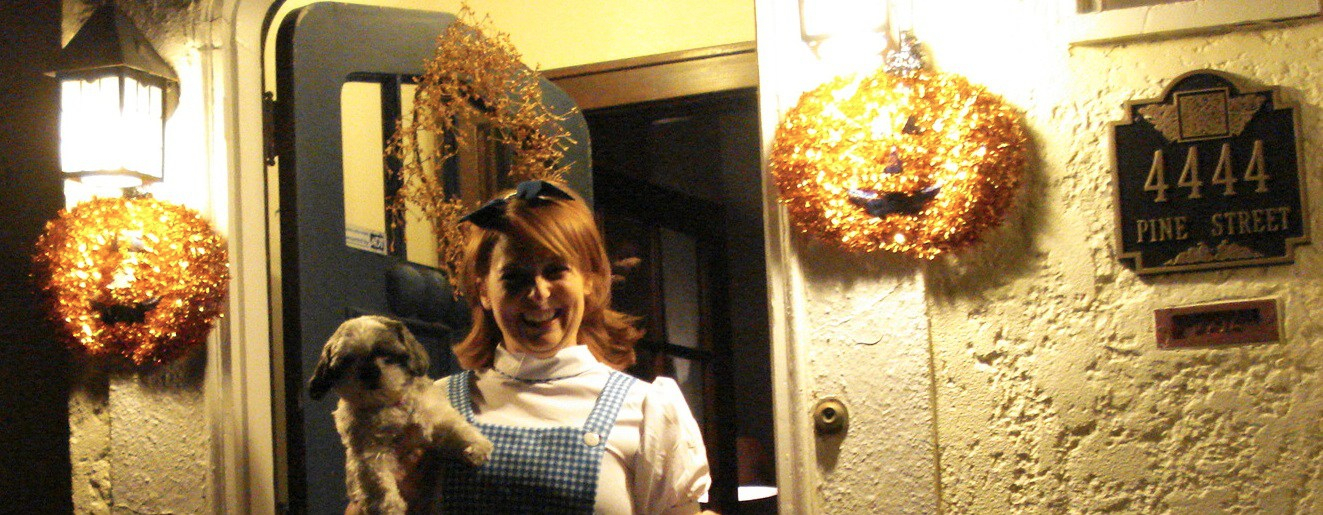
crophalloween.jpg

Here we are again at your signature time of year, Kissie. The fourth autumn since your death. Your favored season for all its customs, merriments, and breathtaking transitions, and of course, the soulful wonder of it all.

That last October brought so many unexpected gifts — a rare, laugh-filled overnight with brother Joe, a chance to try my hand at homemade Runzas to tempt your waning appetite, and though I didn’t know it then, the last time I would find myself alone with you in your beautiful desert home. Just us, whiling away those three precious, glittering days in Arizona.  We were so contemplative and nostalgic, wistful and compassionate in our remembering. We talked about Midwestern autumns, Halloweens of yore, the people we’d become — somehow, our greatest accomplishment.

Eric reminds me that I miss you year-round, and regularly reference seasonal markers and cultural touchstones spanning fifty years. All true, but fall is different. Family and friends alike can’t help but recall how you came alive when the night air cooled, and your annual jaunts to Omaha to gallivant the boulevards, kicking up mounds of maple leaves with little Peony by your side.  Oh, how I miss your pure, unencumbered exuberance.

Thank you Nana, Mom, and Dad for encouraging us as children to embrace this season’s pageantry, mystery, and connection — with each other and our beloved relatives gone before us. Thank you, Kissie, for showing me how to do it with panache.

Immersion

Here is a poem I’ve come to love, followed by my reflections. It’s by Barbara Crooker from her collection “Gold.”

Grief
is a river you wade in until you get to the other side.
But I am here, stuck in the middle, water parting
around my ankles, moving downstream
over the flat rocks. I’m not able to lift a foot,
move on. Instead, I’m going to stay here
in the shallows with my sorrow, nurture it
like a cranky baby, rock it in my arms.
I don’t want it to grow up, go to school, get married.
It’s mine. Yes, the October sunlight wraps me
in its yellow shawl, and the air is sweet
as a golden Tokay. On the other side,
there are apples, grapes, walnuts,
and the rocks are warm from the sun.
But I’m going to stand here,
growing colder, until every inch
of my skin is numb. I can’t cross over.
Then you really will be gone.

***************************************
She doesn’t say she won’t cross over, but that she can’t. In this, the poet recognizes the seismic impact of a significant death. For me, it also speaks to grief’s import in my personal growth and relationships. Moreover, to force the passage of my grief, to “move on” too quickly, feels unnatural. Particularly the phrase, “nurture it like a cranky baby, rock it in my arms,” suggests an instinctive cleaving to grief, and the acceptance of a mourning time – a time like childhood, to be cherished and gleaned for its truths. Like childhood and water, it is moving, and will inevitably change. The insights and ongoing connection to Kissie that grief has offered me are personal (“It’s mine”), and though they will likely (hopefully) be long-lasting, they are not static.

Significantly, this poem counsels me to respect where I am in grief, to resist turning away from my individual mourning as chronos time (like “water parting around my ankles”) marches on, and cultural dictates urge me to put it, and therefore Kissie, behind me. My mourning and my love cannot be separated.

The poet also acknowledges that even in grief life remains beautiful (“Yes, the October sunlight wraps me in its yellow shawl, and the air is sweet as a golden Tokay”), but that to fully sever it, is to orphan ourselves.

Time, and time again

The passage of time, the marking of it, has never been stranger than since you died. Dates, seasons and their associated import and memory, seem to be tattooed just under my skin – out of sight, but exerting themselves effortlessly into consciousness (or semi-consciousness) at the appointed time. Anniversaries of all sorts – doctor appointments, hospital stays, trips we took, last times we did this or that – especially that last year, are sentinels of significance that I appreciate and long for, even if they’re painful. When I look at the actual calendar and my record of events for confirmation, I think, “ah yes, no wonder I feel this way.”

As I mentally and emotionally move through the chronology of 2013, the turning over and remembering of its defining moments, I’m negotiating, as I must, the present-moment. It seems to me a kind of slipstream time, the present. A time oddly hidden from itself. More like a shadowed or cocooned time. Time that is pulled somehow, largely invisible, and without a sense of perceptible movement, but definitely evolving. A waiting, suspended kind of time the clock-driven world is impatient with, and sometimes I feel like I’m a step behind (or ahead) even while all appears to be moving at the expected and customary pace.

Because time has felt so surreal since your death, it helps me to think about the ancient Greek understanding of time. They defined time as either chronos – sequential, chronological time – or kairos – “a time when conditions are right for the accomplishment of a crucial action.” In short, kairos being a more conditional or subjective understanding of time, and chronos more objective and measurable.  These past three years, this slipstream of time, feels more indeterminate and evolving, more kairos than chronos, even though intellectually I understand it is both. I feel less anxious when I consider the time I’m experiencing now as kairos time. It has a liminality I try to embrace, and it feels especially crucial. Most of all, you seem to exist here. We exist here.

If I Were a Bird

mnnov-2009

“Delicious autumn! My very soul is wedded to it, and if I were a bird I would fly about the earth seeking the successive autumns.”
-George Elliot

This quote is so you. When I read it on your party invitation, it took my breath away. And when you tossed those leaves for joy that early November day, no doubt was left, it was your favored season. You must be that bird – the way you’d flit through golden days with all your brilliant gusto – I seem to sense you more intently now. But it could be that I’m the bird, flying about this home of ours, and in every tree and cloud, seeking you.

Rest Area

Lying on the couch
awake since three
in the nursing home
with my dad
and all the other
saints of survival

I watch his skeletal
frame disappearing
into the pitch
dark bedroom.
Each shuffle step
a psalm of frailty.

Eighty-nine year old
bones still moving.
Still holding him up
in this weighted world.

On the drive home
I feel myself fading.
When I realize
that I can’t remember
the last few minutes
I pull off.

In the rest area
I sleep in the front seat
with the windows down.
The sun and wind flow in
along with the smell
of warm sweet grass.
When I wake
I am lost in the world
for a wonderful moment.

I climb out of the car
and slowly walk the perimeter
of the picnic area.
There are no people.
Just a lone semi
parked by the edge
of a corn field.
A driver named Winkle
may have been sleeping
in its cab for fifty years.

I find a curved hiking path
mowed into the waist high
“restored prairie”.
It’s surrounded by wildflowers
and tall, brown grasses.

Fifty yards out
there is a sculpture.
A boat with no skin,
only broken ribs.
A plaque explains that it is
symbolic of the Viking explorers.
It has been surrounded
with a fence so
no one will touch it
or get too close.

I watch the fall bloom
    asters
        hyssop
            golden rod and more
rocking back and forth
on the moist wind
coming up from the south.

Monarchs go tumbling by
diving again and again
into the wind
fighting their way
across North America
on paper wings.

Off in the distance
the windmill giants are
waving their arms at something
beyond the horizon.

The earth is tilting.

I think of my father.
No longer able to kneel and pray.
He lies on his back in bed
and prays for the world.
He sleeps and prays.

He has fought
the wolves of loneliness.
He was wounded but now
they lie quietly by his side.
He lies quietly by their side.

When I am with him
(and even when I am not)
I feel his grace.
It gives welcome weight
to the ballast that’s needed
in this storm of days.

Back in the wild field
an old fence post holds
a twisted strand of wire.
It sings so softly with the wind
that it can hardly be heard.
It sounds like the ghost
of a drowned woman
calling from far
beneath the water.

I am in love
with these quiet things
that have nothing
to do with survival.
I stand in the field
listening to this sad music
and watch as a long
spine of clouds
slowly bends itself
over the ancient world.

– Kevin Lawler
********************************************
More poetry by Kevin Lawler can be found at Winding Road.